
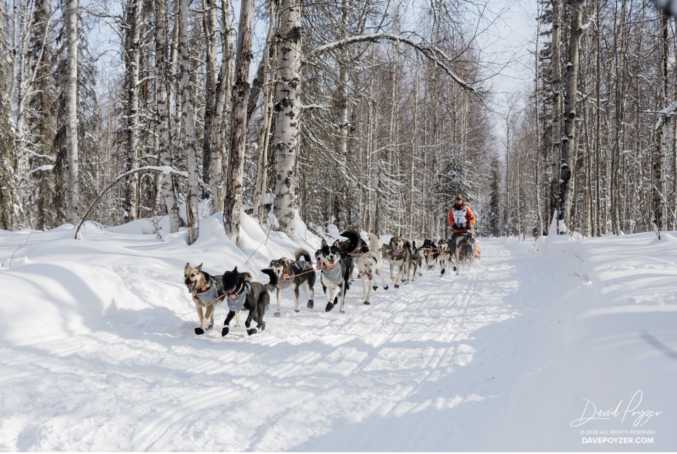
While it’s a new day on the Iditarod trail, but before going down the trail, let’s look back to last night – 21:00. Ryan Redington in bib #5 was the first musher into Skwentna at 20:59. From Yentna, Ryan covered those 30 river miles in 2 hours and 59 minutes at an average speed of 10.6 mph. Here’s how that stacks up with arrival times since 2020, excluding the Deshka start in 2021 and the Fairbanks start in 2025.
Looking back at 2020, Robert Redington arrived in Skwentna at 23:40. That was a slow run through deep newly fallen snow. In 2022, the first four mushers, led by Ryan Redington arrived in Skwentna between 21:23 and 21:45. In 2023, Ryan Redington was again first into Skwentna at 20:51. In 2024, Mille Porsild made Skwentna at 21:03 followed by Ryan Redington at 21:15. Remember, Ryan won in 2023. So if he’s trying to run a similar schedule, he’s within 9 minutes. Ryan has a consistent pattern going with being one of the first teams to arrive in Skwentna and at least in 2023 it paid off.
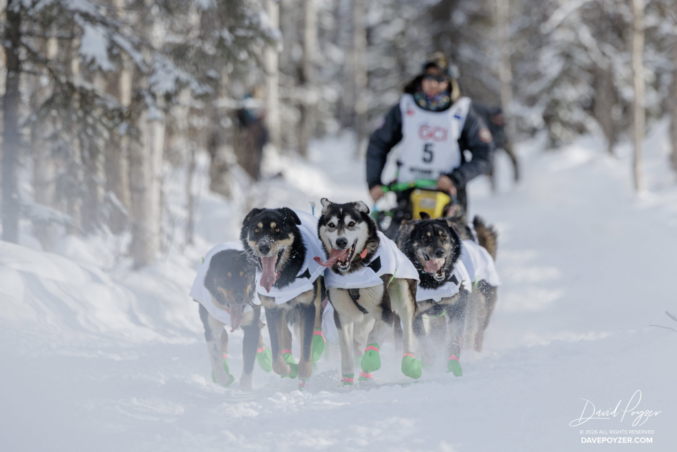
Pre-race, Greg Heister of the Insider, asked Ryan about his team. Ryan isn’t a man of many words and his reply was slow and measured. Some of the dogs are from his kennel. Some of the dogs are from his parent’s kennel (Raymie and Barb) and one dog is from his brother and nephew’s kennel (Ray Jr. and Isaac). He said, “This is a team I’ve dreamed of putting together for a long time.” His reply to the question was carefully delivered. Was he just being humble about his talented team and his chance of a repeat championship? Perhaps as there was a definite twinkle in his eye and pride in his voice.
Now at 21:00 last evening, with Ryan resting after just arriving in Skwentna, most of the flags on the tracker were orange indicating nearly every team resting either in Yentna or between Yentna and Skwentna. The GPS map looked like a solid orange line covering the trail with an occasional green spec. The vast majority of teams were resting, not traveling. That gets back to each musher setting up their run/rest schedule according to the plan they have crafted and re-crafted since deciding to enter Iditarod 54.
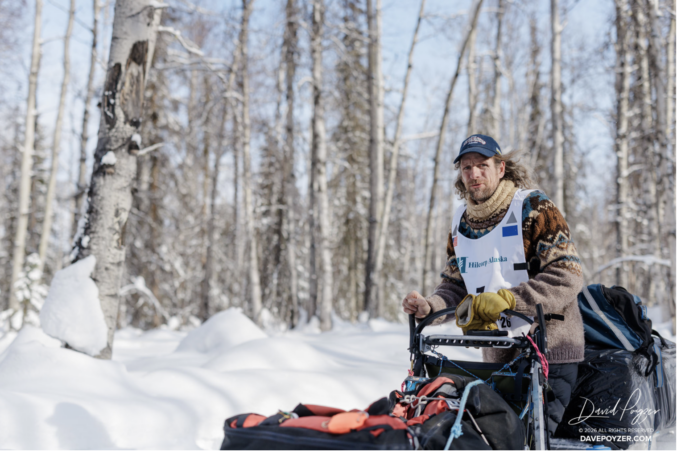
What’s Jessie Holmes up to? He left Willow, ran about 6 hours then camped for two hours before reaching Skwentna. He stayed on the river at the Delia homestead for only 15 minutes before heading on to Finger Lake. That run from where he camped before Skwentna to Finger was just over 6 hours. He’s settled down on the lake to rest before tackling the Happy River Steps in route to Rainy Pass.
Earlier this year, Holmes won the Copper Basin 300, repeating his championship of 2025. He said his goal for this year was to repeat his wins from last year. Well, check that box for the Copper Basin. He’s currently on the trail executing his plan for a repeat of Iditarod. Beyond that he’ll seek a repeat in the Kobuk 440 out in Kotzebue. Holmes doesn’t hold back when he talks about his intentions in the Iditarod – ABSOLUTELY REPEAT! In conversation with ADN, Holmes said the first championship was important but then implied that the first was not as important as cementing his right to be a champion with the second win. As of Iditarod Holmes has 4,500 miles on his team. A well trained Iditarod team has around 3,000, The Holmes team is tuned both mentally and physically. They are ready!
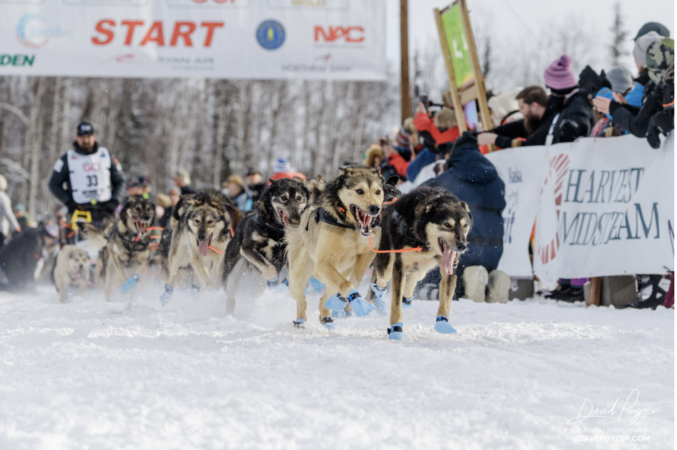
Earlier this year, 2019 Iditarod Champion, Pete Kaiser earned his tenth Kusko 300 Championship. He stands alone atop the Kusko record board. Kaiser, a late comer to the 54th Iditarod, was perhaps encouraged by his team’s performance in the Kusko. He’s wearing bib #33, has moved up toward the front of the pack, and is one of 10 teams to have reached Finger Lake at mile 123. Kaiser told the ADN guys that he’ll wait until he’s well into the race to decide about “racing.” Kaiser also said the field has many potential winners but defending champion, Jessie Holmes, is the favorite.
Paige Drobny is back to race Iditarod after placing third in 2025. The Squid Acres handlers and Paige dressed the part at the ceremonial start, all wearing colorful squid outfits. Paige won’t say she has her eye on the prize but emphasizes that she has a plan and will stick to that plan with the goal of running the race her dogs are capable of. It’s about schedule and discipline. Follow the plan and let the chips fall where they may. Right now the Squid team, Bib 10, is resting in Finger Lake with eight other top contenders.
Matt Hall, a Yukon Quest champion who has finished as the Iditarod runner up in the 24 and 25 is hungry and believes he has the team to challenge Jessie Holmes for Iditarod 2026 gold. Hall has a very experienced team and says their success will come from the decisions he makes as their coach. There’s a lot to consider out on the trail and Hall will have to respond to trail conditions and weather every mile along the way. The Silver Ace team has faced long stretches of extreme cold while training this winter. Hall and his team will be well adjusted to the temperature extremes forecast for the Interior of Alaska while the teams pass through on their way to the Yukon River. Born in Alaska and having grown up running a trap line with his dogs, Hall says what he likes best about the Iditarod is the competition.
Thomas Waerner and Kjell Rokke spent a few short minutes in Finger Lake then departed to rest a mile down the trail. That practice has become common place in the past races. There would be a couple of reason. When a team leaves the checkpoint, other competitors don’t really know exactly what they are doing or where they are – running or resting? It also is quiet. The dogs get much better rest compared to being parked in the midst of ten other dogs teams.
Waerner and Rokke are in the Expedition Class, thus not eligible for Iditarod prize money or awards. They are there to experience the whole trail, which for 2020 Iditarod Thomas Waerner isn’t anything new. He and Rokke have been running in Alaska on the National Historic Trail for the past four years. During one of those mushing trips, they dreamed up the concept of doing the whole trail, not as competitors but at the same time and while contributing to the race. Was it their idea to propose this expedition class? Perhaps. Waerner has said they are racing against time, not the rest of the competitors. Their run/rest schedule up to this point has been run 6 hours, rest two, run 7 and rest just beyond Finger. The Norwegians are known for running long slow paced runs and resting short. Watch their race to see if this is their plan for 2026.
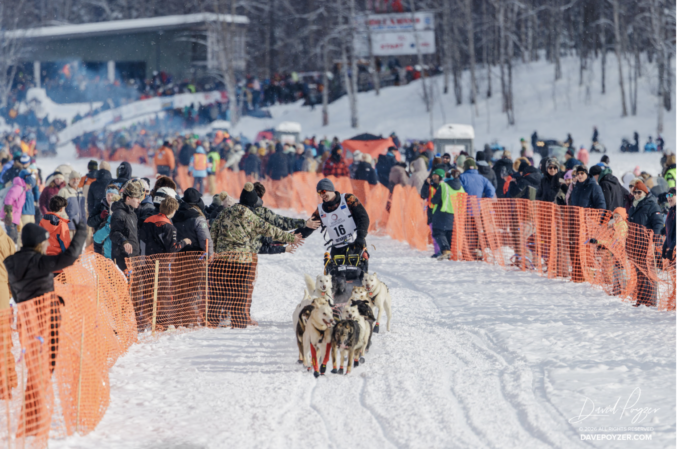
Enjoy the pics from Insider photo guy David Poyzer. Siri Raitto is also on the trail with her camera and has photos in the photo gallery for you to enjoy. A picture is worth a thousand words!