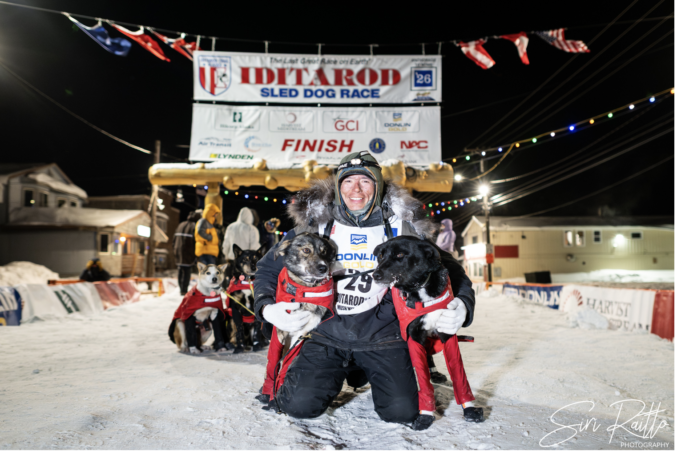
Rookie Jessie Terry of Sioux Lookout, Ontario mushed to the arch in 14th place on March 19th at 03:36. The rookie with the best time is honored as Rookie of the Year. Jesse completed the run in 10 days, 13 hours and 36 minutes with 12 dogs in harness. Jesse’s passion for mushing began in childhood when his father purchased a few sled dogs instead of a snowmachine. That’s a decision Joe Redington, Sr. would applaud! Jesse began mushing at the age of 11. His racing career started with sprint races, then moved to mid-distance and now he owns the coveted Iditarod finisher’s belt buckle. He’s also leading the contest for Fastest Time Safety to Nome with a run of 2:56 besting Jeff Deeter’s 2:58.
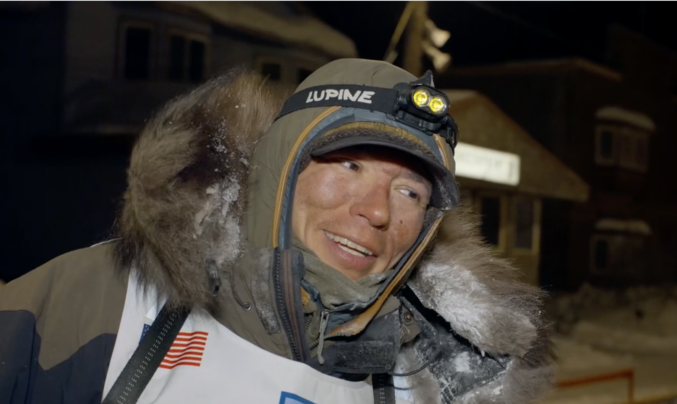
At the arch, Jesse said he came to Iditarod because he loves running his dogs in new places. He said, “I’m living my dream, how could I not be happy. I’m proud of these dogs having great speed at the end of a 1,000 race.” Jesse said the wind over Topkok was intense. His sled tipped over a few times on the icy side hills. Jesse is a sled builder, working alongside Iditarod and Yukon Quest veteran Hans Gatt.
The Rookie of the Year Award, presented by the Peldiak Family, comes with a beautiful trophy that will be presented to Jesse at the Finisher’s Banquet as well as an additional cash prize of $2,000.
Jesse Terry and Sam Martin were in a close contest for Rookie of the Year over most of the race with Kevin Hansen challenging from behind. Everything was going in Sam’s favor up through Elim. Sam came into Elim at 21:33 with Jesse arriving at 22:53. Jesse cut rest to depart at 03:42 with Sam close behind at 03:44. Jesse’s average speed to White Mountain was 7.13 mph while Sam’s was 6.26 mph. Sam arrived in White Mountain 56 minutes behind Jesse. It would be a race for these two guys to the Nome. With an average speed of 8.64 mph, Jesse reached Safety at 00:31. Sam followed at 03:13 going 6.96 mph. At 7.5 mph Jesse arrived in Nome ahead of Sam who covered the final 22 miles at 6.88 mph.
With every musher coming to the burled arch on Wednesday and early Thursday , the wind was evident. Flags over the finish line were definitely flapping in the wind actually rather than hanging vertically, they were nearly horizontal thanks to the wind. No wonder the times from Safety to Nome were mostly over the 3 hour mark. After besting the winds early in the race near Rainy Pass, coming into Unalakleet and the winds coming over Topkok and through the blow hole, why wouldn’t the wind be blowing in Nome?
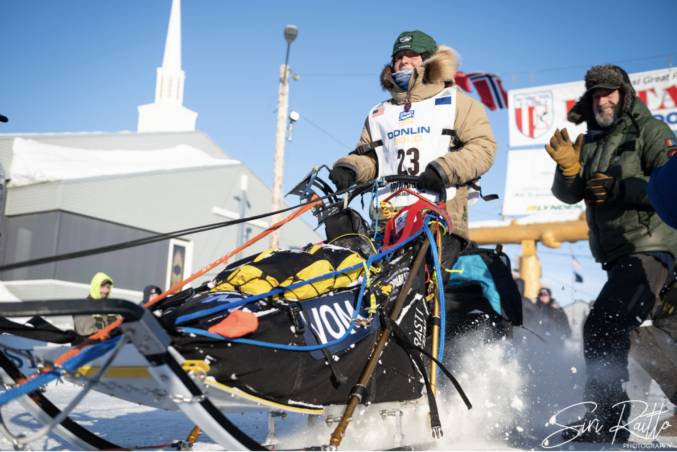
Late on March 18th, Hanna Lyrek earned 11th place in Iditarod 54 with a time of 10 days, 5 hours and 3 minutes. Hanna, who was born in Anchorage now resides in Alta, Norway which she describes as being way north. Lyrek is a “Jill” of all trades in the family sled dog business so coming to Alaska to race Iditarod is somewhat of a winter vacation. Hanna’s mother, Trine, finished the 2005 Iditarod in 37th out of 79 mushers. Hanna’s father, Don is an Iditarod veteran of the 1995 race. Hanna has run the longest races in Norway but says they are different than Iditarod. Iditarod is unsupported while in Norway, mushers are supported by crews who travel from checkpoint to checkpoint with vehicles. In Iditarod, all the decision are made by the musher who does all of the dog care.
When Hanna approached Nome in 2022 as a rookie, she decided she was going to return to race again. Iditarod was the greatest adventure she’s ever had on a sled with her dogs. Hanna worked and saved to make her second Iditarod a reality. The first priority was to train and build a team strong enough for the 1,000 mile run.
Then she had to face the nightmare of logistics necessary to get 16 dogs to Alaska from Norway. They drove from Alta in the north of Norway to Oslo. Hannah flew Oslo to Seattle. Handlers drove the dogs to Luxembourg where they flew to Seattle via cargo plane. Hanna met them in Seattle. Eight dogs flew to Fairbanks and eight dogs flew to Anchorage where Hanna picked up a truck and trailer then drove them to the kennel they’re using located outside of Fairbanks. Lyrek said it’s rewarding to get the logistics figured out so they can race in Alaska.
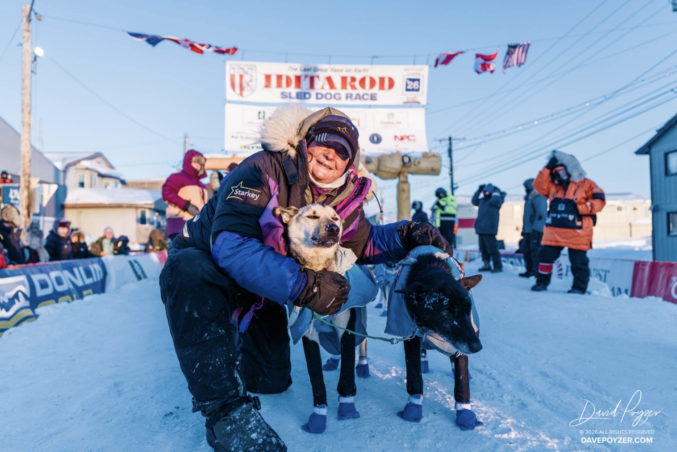
Veteran musher, Jessie Royer finished with 12 dogs in 12th place with a time of 10 days, 6 hours and 45 minutes. Royer is now a veteran of 22 Iditarods with a perfect record – no scratches. Royer was the most experienced musher on the trail for 2026. With the retirement of Aliy Zirkle, Jeff King, Martin Buser and others, younger mushers – Pete Kaiser, Michelle Phillips, Jason Mackey, Paige Drobny, Mille Porsild and Royer have become the voices of experience in the race.
Royer has been running Iditarod since 2001 when she earned Rookie of the Year honors with 14th place. She’s had 9 top ten finishes including 4th in 2015, and 3rd in 2019 and 2020. On the 2020 northern run she finished in 9 days 17 hours and 47 minutes. In her most recent northern run in 2024 she completed the race in 9 days, 18 hours, 49 minutes. Royer has had sled dogs since the age of 15 when she began learning from one of the best, celebrated 4 time Iditarod champion, Doug Swingley.
At the arch, Royer said with no wind along the coast, she was feeling cheated out of the full Iditarod experience but the winds on Topkok made up for it. Some places were pretty brutal. While fighting sickness on the Yukon River, Jessie lost her motivation to race. All things considered, a finish in 12th place was a victory.
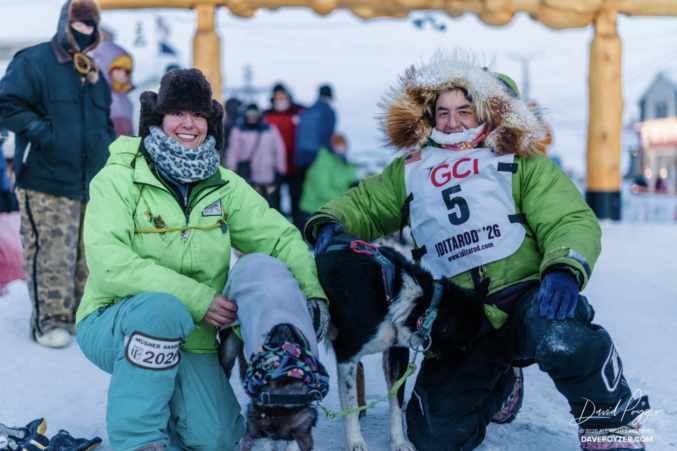
Veteran musher, Ryan Redington finished with 8 dogs in 13th place with a time of 10 days, 7 hours and 2 minutes. Ryan began his Iditarod career in 2001 and has finished 12 of 19 runs. Ryan became the first Redington to win the Iditarod in 2023. With that victory he has five top ten finishes. Ryan put together what he called his dream team for Iditarod 54. He had 6 of his own dogs, 8 dogs for his parents (Barb and Raymie), a dog from his brother and nephew’s (Ray Jr. and Isaac) kennel and a dog from the Berington twins. Ryan said it was a team he’d been dreaming of putting together for quite some time. The practice of using the best dogs from a few kennels is nothing new to Iditarod. The Norwegians have frequently pooled their dogs.
Ryan keeps coming back to the Iditarod because he thinks about it every day of the year. He says, “I love the race and I love the dogs.” At the arch Ryan thanked Paige, Mille and Michelle for helping him out when he was sick. That was really great sportsmanship.” His final comment before taking his team to the dog lot was to congratulate Jessie Holmes.
Rookie Sam Martin came to the burled arch in 15th place with 10 dogs in harness. His run time was 10 days, 16 hours and 59 minutes. Martin ran a team from Failor’s 17th
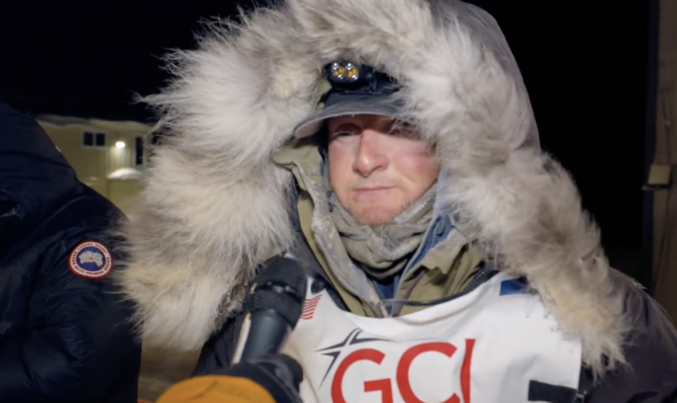
Dog Kennel. Sam was introduced to mushing through a summer job ten years ago with Alaska Icefield Expeditions. From that experience Sam realized he enjoyed working with sled dogs and wanted to continue. Now he’s part of the 17 Dog Crew, working for Mathew and Liz Failor. Sam says, “You can’t ask for better co-workers or office space, the dogs and being outside is what makes it the best lifestyle there is.” At the arch Sam said the race was a lot of hard work but it paid off in a lot of ways. More importantly, now he knows what it’s about.