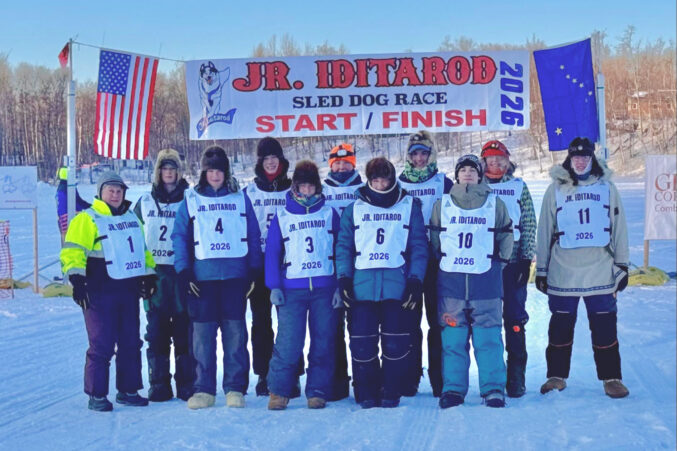
For the 49th Jr. Iditarod, Mother Nature has provided temperatures that sled dogs love to run in. Their humans on the other hand would prefer a few degrees warmer. At 0800 when the teams parked on Knik Lake, it was minus 13 degrees, winds were from the NNW at 2 mph and the skies were mostly clear. Throughout the day as the teams made their way to the Yentna Station Road House where they will camp in the woods along the big bend of the Yentna River, the winds remained light and the temps rose to a few degrees above zero but not by much. With the cold, the trail is predicted to be hard and fast for the race.
Here’s the starting order that was determined last night by drawing for bib number at the musher meeting. For your information, previous Jr. Iditarod finishes are also listed for each of the Jr. Iditarod veterans. Good luck and God speed to all the mushers.
10:02 Bib 2 Stanley Robinson Rookie
10:04 Bib 3 Hazel Sutton Veteran – 2025 11th
10:06 Bib 4 Addy Pederson Veteran – 2024 13th, 2025 10th
10:08 Bib 5 Thale Randall Rookie
10:10 Bib 6 Mckena Hanson Veteran – 2024 11th, 2025 4th
10:12 Bib 7 Keira Irish Veteran – 2023 11th, 2024 8th, 2025 8th
10:14 Bib 8 Isaac Redington Veteran – 2023 5th, 2024 3rd, 2025 2nd
10:16 Bib 9 Rosemary Maixner Rookie
10:18 Bib 10 Sam Perez Rookie
10:20 Bib 11 Torlief Bentzen Veteran – 2024 18th
You’re wondering where’s bib #1. Bib #1 is reserved for the honorary mushers. The Jr. Iditarod introduced Bruce and Diana Moroney as their 2026 Honorary mushers. As pilots for the Iditarod Air Force, Bruce and Diana have flown an enormous number of missions in support of the Jr. Iditarod and the Iditarod delivering personnel, supplies and dogs up and down the trail. Air support isn’t their only contribution to the Jr. Iditarod. Being Iditarod veterans, they have mentored young mushers and offered up their own equipment and dogs for the teens to use to realize dreams of competing in the Jr. Iditarod and other junior racing events. All of the 2026 Jr. Iditarod contestants signed bib #1 which was then presented to the Moroneys. They’ll be at the start this morning wearing Bib #1 and perhaps flying race personnel out to Yentna this afternoon and back tomorrow.
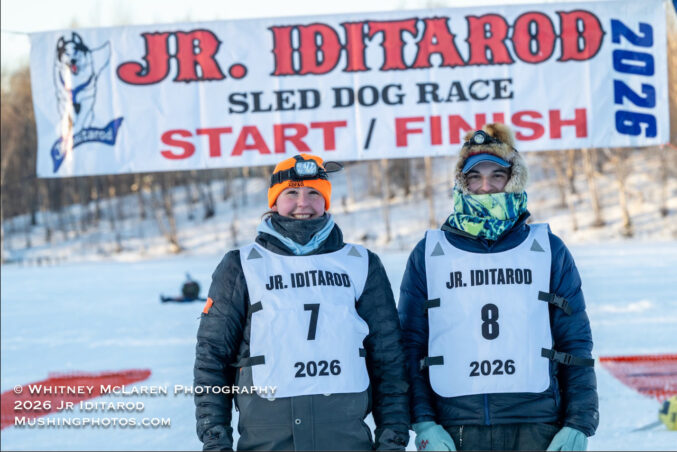
Three of the 2026 mushers will be graduating from Jr. Iditarod at the completion of this race. Keira Irish, age 17, of Fairbanks and Isaac Redington, age 17, of Knik are participating in their fourth and final Jr. Iditarod. Torlief Buntzen, age 17, is running his second but final Jr. Iditarod. Wishing these young adults all the best for a bright future. Keira is dual enrolled at Lathrop HS and UA-Fairbanks and plans to continue at UAF to earn a degree in biology. Isaac, is currently attending high school at Redington Jr/Sr HS. Isaac plans to attend UA-Fairbanks after graduation. Torlief is considering a career in Wildlife Biology. It’s delightful to hear that these accomplished young mushers plan to continue mushing in the future.
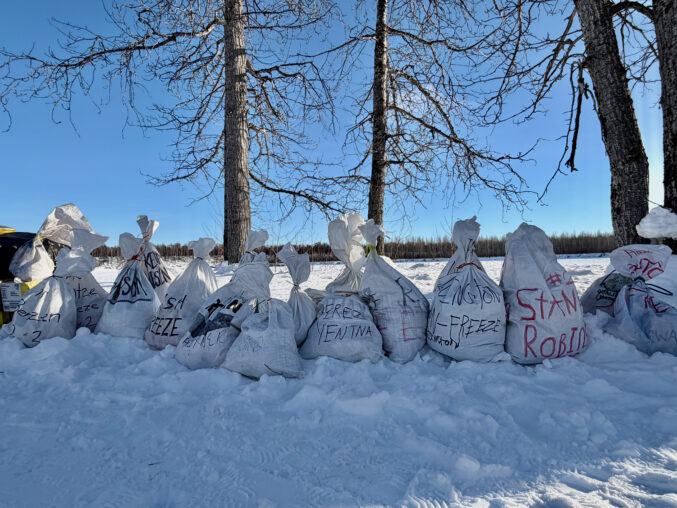
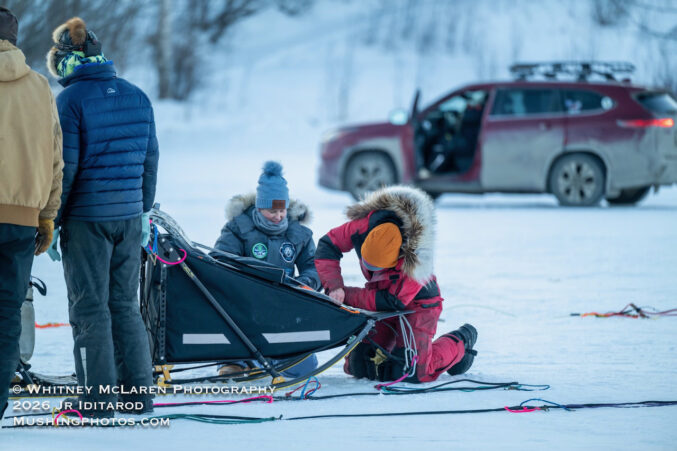
On the journey out to the halfway checkpoint the dogs will be snacked regularly every couple of hours. The mushers will spend the required 10 hour layover at Yentna. Upon arrival their first order of business will be to remove booties, spread straw and heat water for feeding their dogs. They’ll tend to the feet of their athletes and massage shoulder and tricep muscles. The dogs will sleep and then the mushers will have time for their own supper and some rest.
Perhaps you wonder how sled dogs run these distances, eat, rest for a few hours and then enthusiastically run more miles. Sled dogs are very efficient at digesting food and turning it into energy. Their bodies quickly metabolize food sending glycogen to the muscles. They are also capable of pulling fat from the blood stream to use as an energy source. When racing, nearly 60% of a sled dog’s diet is fat based. Due to their super metabolic processes, the fat becomes available as fuel very quickly. The other 40% of their diet consists of carbohydrates and protein. Human athletes are envious of these amazing sled dogs.
A tradition at the Yentna camp out is the bonfire. Many of these teens have become good friends over the years while competing in this and other races. As they gather around the fire to enjoy the warmth, they also get to enjoy good times with old friends and make new friends. The first couple of mushers to arrive usually take care of building the fire with wood provided by the Gabryszak family, gracious hosts of the checkpoint.
How is it that the first musher to reach the finish line is the winner when they start at two minute intervals? Start differential is made up at the end of the 10 hour layover. Torlief, being the final musher to leave the start will be released from Yentna after spending 10 hours. Sam, the 9th musher to start, will stay at Yentna for 10 hours and 2 minutes. Rosemary, the 8th musher to start, can depart with a rest of 10 hours and 4 minutes. You see the pattern here. Stanley in bib #2, the first musher to leave Knik Lake, will need to stay at Yentna for 10 hours and 18 minutes. The same process is followed for the Iditarod, adding start differential to the 24-hour required rest. By adding the start differential to the required rest during the race, the first musher to cross the finish line is actually the winner.
Teachers who use Iditarod as a theme for education in their classrooms will find the Jr. Iditarod to be an excellent lead up to following the Iditarod. First, the students feel more of a comradery with these teenage mushers. Then, the Jr. Iditarod offers a smaller scale opportunity to work with and understand timing and start differential. Getting acquainted with GPS Tracker for location and speed. How about military versus civilian time? To avoid the use of AM and PM to designate arrival and departure times from checkpoints, both races use military time. Jr. Iditarod provides practice in using the 24-hour military clock. Speaking of using the Jr. Iditarod as a warm up for the Iditarod, how about doing some practice in switching between Fahrenheit and Celsius temperature scales as there are some mushers participating in the Iditarod that use the Celsius scale in their home country? Who are those mushers?
Five hours into the race, all teams have passed through the Deshka Landing checkpoint at mile 41. From there it’s 35 miles to Yentna. Leaders Thale Randall and Stanley Robinson are averaging just over 12 miles per hour. Isaac Redington and Hazel Sutton are not far behind while averaging 11.4 mph and 10.8 mph respectively. Sam Perez and Torlief Bentzen at the back of the pack are running about 9.5 mph. At this pace, the first teams should pull into Yentna at about the six hour mark and the final mushers between the 8 and 9 hour mark. As expected with the cold temperature, the trail is a fast one. Follow the Jr. Iditarod through the Jr. Iditarod Facebook page and at jriditarod.org where GPS Tracker is available as well as current standings.